

On this Page:
- Support Items
- Support Purposes
- Units of Measure
- Service Agreements
- Service Booking an NDIS Support Worker for the NDIA
- Claiming for support items that do not have a price limit
- Short Notice Cancellations
- Expenses Related to Recreational Pursuits
- Core – Transport
- General Transport
- Provider Travel
- Provider Travel – Labour Costs (Time)
- Provider Travel – Non-Labour Costs
- Core – Assistance with Daily Life
- Daily Personal Activities
- Assistance with Self Care Activities
- Specialised Home-Based Assistance for a Child
- Therapy Supports and Early Childhood Supports
- Assistance with Personal Domestic Activities & House or Yard Maintenaince
- Core – Assistance with Social, Economic and Community Participation
- Participation in Community, Social and Civic Activities
- Capacity Building – Increased Social and Community Participation
- Community Participation Activities
- High Intensity Supports
- Implementing Intensive and Complex Behaviour Supports
- High Intensity Daily Personal Activities: Assistance with Self Care Activities
- HIS – Participation in Community, Social and Civic Activities
NDIS Funding & Pricing: A Summary
In most cases, support items subject to price limits have a single national price limit. In some cases, there are different price limits for different jurisdictions. Higher price limits can apply in remote and very remote areas.
The pricing arrangements not only set the price limits for supports. They also specify when and how supports can be claimed, including what has to have happened for a support to be claimable. Supports can be subject to price regulation in different ways:
- Price controlled supports should only be claimed by a provider from a participant’s plan when they are reasonable and necessary to meet a participant’s needs and are subject to the conditions set out in the NDIS Pricing Arrangements and Price Limits.
- Quotable supports should only be claimed by a provider from a participant’s plan if the support is specifically included in the participant’s plan. They are subject to the conditions set out in the NDIS Pricing Arrangements and Price Limits.
- Some supports are not subject to price control. These supports should only be claimed by a provider from a participant’s plan when they are reasonable and necessary to meet the participant’s needs. They are subject to the other conditions set out in the NDIS Pricing Arrangements and Price Limits.
The NDIA does not set the prices that providers charge participants. Each provider must agree the price for each support with each participant, subject to the price limits and pricing arrangements that are imposed by the NDIA.
In general, providers should not charge NDIS participants more for a support than they would charge anyone else for the same support. If the price a provider offers to a NDIS participant is different to that which they would offer to a person who was not an NDIA participant, then the provider should ensure that the participant is aware of this difference and the reasons for the difference.
Plan managers must provide the Australian Business Number (ABN) of the service provider who delivers the support for all payment requests.
Self-managing participants can use registered or unregistered providers and are not subject to the price limits or other pricing arrangements set out in the NDIS Pricing Arrangements and Price Limits and its associated documents.
Support Items
Each support that a provider supplies to a participant can be classified as one of the support items listed in the NDIS Pricing Arrangements and Price Limits and in the NDIS Support Catalogue. Providers should claim payments against the support item that aligns to the service they have delivered. Each support item has a unique reference number.
Support Purposes
NDIS participant budgets are allocated to three separate support purposes:
- CORE – Supports that enable participants to complete activities of daily living. Participant budgets often have a lot of flexibility to choose specific supports with their core support budgets, but cannot reallocate this funding for other support purposes (i.e., capital or capacity building supports).
- CAPITAL – Investments, such as assistive technologies – equipment, home or vehicle modifications, or for Specialist Disability Accommodation (SDA). Participant budgets for this support purpose are restricted to specific items identified in the participant’s plan.
- CAPACITY BUILDING – Supports that enable a participant to build their independence and skills.
Participant budgets are allocated at a support category level and must be used to achieve the goals set out in the participant’s plan. Support categories are aligned with the NDIS Outcomes Framework:
- Daily Living
- Home
- Health and Wellbeing
- Lifelong Learning
- Work
- Social and Community Participation
- Relationships
- Choice and Control
Units of Measure
The NDIS payment system includes units of measure for each support item as: Each, Hour, Daily, Weekly, Monthly, or Annually.
Providers should ensure that they record claims against a support item using the appropriate unit of measure for the support item.
Registered Providers can only make a claim for payment for a support once they have delivered or provided that support.
Service Agreements
A Service Agreement is a formal agreement between a participant and provider. They help to ensure there is a shared understanding of:
- Expectations of what supports will be delivered and how they will be delivered; and
- The respective responsibilities and obligations of the provider and the participant and how to resolve any problems that may arise.
Service Agreements should be simple and set out how and when supports will be delivered.
A copy of Lived Experience’s Service Agreement is available here:
Service Bookings
If a participant’s plan is managed by the NDIA, then a service booking is required before supports can begin. Service bookings are used to set aside funding in a participant’s plan for a registered provider for a support they will deliver and can be made by the participant or provider in the myplace portal. Providers also claim payments against the service booking in the myplace portal and each service booking sets out the specific support items or support category delivered and period of service delivery within the plan dates.
The Agency recommends that service bookings should be created at the category level, where possible. This allows providers and participants to negotiate or access supports on a more flexible basis, especially for on-the-spot assessments or less predictable support needs. A provider must have a service booking in place to make a payment claim in the Portal.
Claiming for support items that do not have a price limit
Where a support item does not have a price limit then the provider and participant should agree on the reasonable price for the support. If necessary, they should also agree on the billing schedule for the support. For example, they might agree that a support should be claimed weekly. These claims are subject to the general claiming rules, including that, in general, supports can only be claimed for after they have been delivered.
- A Saturday Support is any support to a participant that starts at or after midnight on the night prior to a Saturday and ends before or at midnight of that Saturday (unless it is a Public Holiday or Night-time Sleepover Support).
- A Public Holiday Support is any support to a participant that starts at or after midnight on the night prior to a Public Holiday and ends before or at midnight of that Public Holiday (unless it is a Night-time Sleepover Support).
- A Sunday Support is any support to a participant that starts at or after midnight on the night prior to a Sunday and ends before or at midnight of that Sunday (unless it is a Public Holiday or Night-time Sleepover Support).
- A Weekday Support is any other support:
▪ A Weekday Daytime Support is any support to a participant that starts at or after 6:00 am and ends before or at 8:00 pm on a single weekday (unless it is a Public Holiday or Night-time Sleepover Support).
▪ A Weekday Evening Support is any support to a participant that starts after 8:00 pm and finishes at or before midnight on a single weekday (unless it is a Public Holiday or Night-time Sleepover Support).
▪ A Weekday Night Support is any support to a participant that commences at or before midnight on a weekday and finishes after midnight on that weekday, or commences before 6:00 am on a weekday and finishes on that weekday (unless it is a Public Holiday, Saturday, Sunday or Night-time Sleepover Support).
Short Notice Cancellations
Where a provider has a Short Notice Cancellation (or no show), they are able to claim 100% of the agreed fee associated with the activity from the participant’s plan, subject to the NDIS Pricing Arrangements and Price Limits and the terms of the service agreement with the participant. A cancellation is a short notice cancellation if the participant:
- Does not show up for a scheduled support within a reasonable time, or is not present at the agreed place and within a reasonable time when the provider is travelling to deliver the support; or
- Has given less than seven (7) clear days’ notice for a support.
Expenses Related to Recreational Pursuits
Providers should not claim payment from participant’s plans for:
- Expenses related to recreational pursuits, such as event tickets for the participant, as they are not covered by the NDIS; or
- The cost of entry for a paid support worker to attend a social or recreational event.
Core – Transport
Transport enables participants to access disability supports outside their home, and to achieve the goals in their plan.
General Transport
This support item allows a participant to pay a provider to transport them to an activity that is not itself a support – or to a support that is delivered by another provider. This enables the participant to travel to and from appointments or their place of work. This support item is not subject to price limits.
Provider Travel
Providers can claim from a participant’s plan for travel costs in respect of the delivery of a support item if the provider is a sole trader and is travelling from their usual place of work to or from the participant, or between participants.
Provider Travel – Labour Costs (Time)
Where a provider claims for travel time in respect of a support then the maximum amount of travel time that they can claim for the time spent travelling to each participant (for each eligible worker) is 30 minutes in MMM1-3 areas (Metropolitan and semi-rural areas).
Provider Travel – Non-Labour Costs
If a provider incurs costs, in addition to the cost of a worker’s time, when travelling to deliver Face-to-Face supports to a participant (such as road tolls, parking fees and the running costs of the vehicle), they may negotiate with the participant for them to make a reasonable contribution towards these costs. The NDIA considers that the following would be reasonable contributions:
- For a vehicle owned by the provider or the worker, up to $1.00 a kilometre; and
- For other forms of transport or associated costs, such as road tolls, parking, public transport fares, up to the full amount.

Core – Assistance with Daily Life
This support category relates to assisting with or supervising personal tasks of daily life to enable the participant to live as autonomously as possible. These supports are provided individually to participants and can be provided in a range of environments, including the participant’s own home.
Daily Personal Activities
As well as direct service provision, these support items can be used to claim for:
- Non-Face-to-Face Support Provision
- Provider Travel
- Short Notice Cancellations.
Providers of this support can also claim for the costs of: Provider Travel – Non-Labour Costs using support item 01_799_0107_1_1.
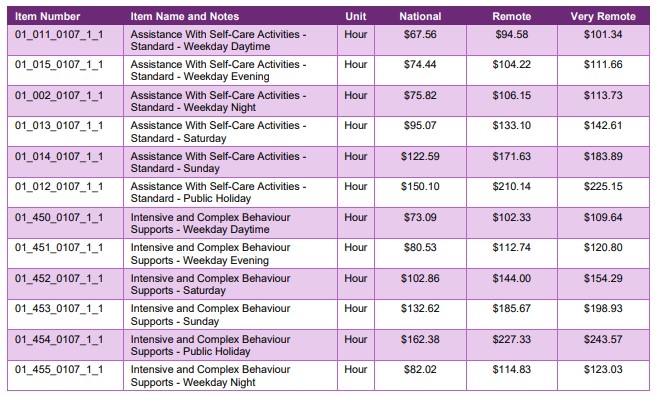
Assistance with Self Care Activities
These support items provide a participant with assistance with, or supervision of, personal tasks of daily life to develop skills of the participant to live as autonomously as possible.
These support items can be delivered to individual participants subject to the rules set out in the NDIS Pricing Arrangements and Price Limits. Providers of these supports can also claim for the costs of:
- Provider Travel – Non-Labour Costs using support item 01_799_0107_1_1.
Specialised Home-Based Assistance for a Child
This support item provides specialist assistance in the home that is required due to additional requirements of a child’s disability and may be provided to strengthen the sustainability of informal supports.
As well as direct service provision, this support item can be used to claim for:
- Provider Travel – Non-Labour Costs using support item 01_799_0104_1_1.
Therapy Supports and Early Childhood Supports
These Disability-Related Health Supports provide care, other than nursing care, to respond to the disability-related health needs of a participant where that care is not the usual responsibility of the health system. They have been temporarily duplicated into the Assistance with Daily Life Support Category so that participants can have greater access to these supports if they need them.
Support items can be used to claim for:
- Non-Face-to-Face Support Provision; and
- Provider Travel – Non-Labour Costs using support item 01_799_0128_1_1 and 01_799_0118_1_1.

Assistance with Personal Domestic Activities & House or Yard Maintenaince
This support item assists a participant to undertake or develop skills to maintain their home
environment where the participant owns their own home or has sole or substantial responsibility for
its maintenance. Includes assisting participant to do basic house and yard work.
This support item can be delivered to individual participants subject to the rules set out in the NDIS
Pricing Arrangements and Price Limits.
As well as direct service provision, this support item can be used to claim for:
- Non-Face-to-Face Support Provision
- Provider Travel
- Short Notice Cancellation – 2 clear business days
- Provider Travel – Non-Labour Costs using support item 01_799_0107_1_1


Core – Assistance with Social, Economic and Community Participation
This support category relates to assisting with or supervising a participant to engage in community, social, recreational or economic activities. These supports can be provided in a range of environments, such as in the community or a centre.
Participation in Community, Social and Civic Activities
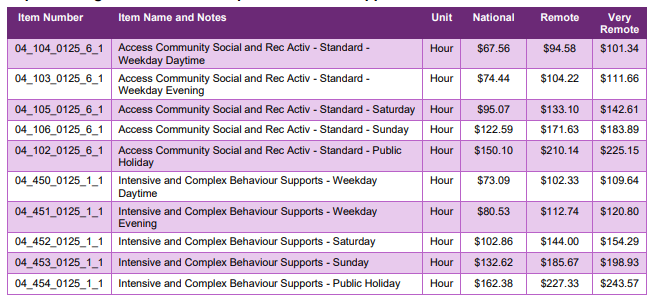
These support items enable a participant to engage in community, social and recreational activities. These support items can be delivered to individual participants subject to the rules set out in the NDIS Pricing Arrangements and Price Limits.
As well as direct service provision, these support items can be used to claim for:
- Non-Face-to-Face Support Provision
- Provider Travel
- Short Notice Cancellations.
Providers of these supports can also claim for the costs of: - Provider Travel – Non-Labour Costs using the support item 04_799_0125_6_1
- Activity Based Transport – Social, Economic and Community Participation Supports using support item 04_590_0125_6_1.
Capacity Building – Increased Social and Community Participation
The supports in this support category allow participants to take part in skills-based learning to develop independence in accessing the community.
Community Participation Activities
This support item is designed to enable providers to claim reimbursement for the costs of enabling a participant to independently engage in community, social and recreational activities when costs of participation exceed an affordable level and without, the participant would be at risk of social
isolation. Participants may use this funding for activities such as camps, vacation and outside school hours’ care, course or membership fees.
This support item can be delivered to individual participants subject to the rules set out in the NDIS Pricing Arrangements and Price Limits.
All supports claimed under this support item need to be reasonable and necessary given the participant’s plan goals. Supports that could be claimed include:
- Universal recreational activities: A limited number of lessons to enable a participant to try out an activity and test their capability and interest in further pursuing this activity – such as horse riding, art, dance or singing classes.
- Attendance at a “camp” or group that builds a participant’s relationship skills and offer a range of activities and opportunities to explore wider interests.
- Other items or adjustments such as customised tools required because of the participant’s disability.
This support item is not subject to price limits. It should only be used to recover the costs of the participant’s attendance at the community participation activities.

High Intensity Supports
A support is considered High Intensity if it is provided to a participant that is one or more of the supports set out in Schedule 2 – Module 1: High intensity daily personal activities of the National Disability Insurance Scheme (Provider Registration and Practice Standards) Rules 2018.
Implementing Intensive and Complex Behaviour Supports
A support is considered Intensive and Complex Behaviour Support if it is implemented with a
participant who, during the course of service provision:
- displays frequent behaviours of concern that have a significant effect on their or others’
wellbeing and safety; and - requires intensive support and the implementation of intensive proactive strategies
(frequent/daily), skill development, and response strategies, which may include the use of
restrictive practices to minimise the risk of harm to themselves or others; and - may, or is likely to, be experiencing other issues that exacerbate or increase the
complexity of their behaviour support needs.
To deliver this support to a participant the provider must:
- be implementing behaviour support (as described above) with the participant and in
accordance with their interim or comprehensive behaviour support plan; and - be registered and assessed for Module 2A (Implementing Behaviour Support Plans); or
- have submitted a registration amendment application or new registration application to
the NDIS Quality and Safeguards Commission including a completed audit assessment
against Module 2A by 30 June 2025.
High Intensity Daily Personal Activities: Assistance with Self Care Activities
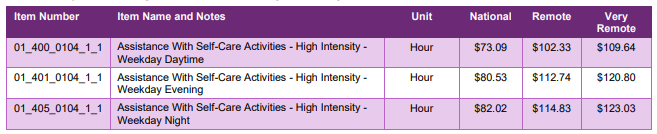
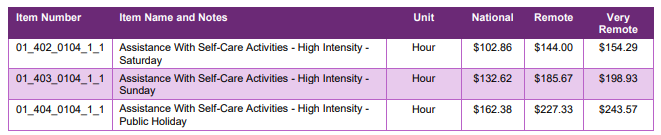
These support items provide a participant with a need for High Intensity Supports with assistance with, or supervision of, personal tasks of daily life to develop skills of the participant to live as autonomously as possible.
As well as direct service provision, these support items can be used to claim for:
- Provider Travel – Non-Labour Costs using support item 01_799_0104_1_1.
- Non-Face-to-Face Support Provision
- Short Notice Cancellation – 7 days
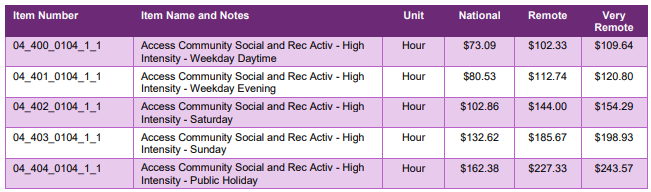
High Intensity Supports – Participation in Community, Social and Civic Activities
These support items enable a participant who requires High Intensity Supports, to engage in community, social and recreational activities in circumstances where a more skilled or experienced support worker is required. They can be delivered to individual participants subject to the rules set out in the NDIS Pricing Arrangements and Price Limits.
As well as direct service provision, these support items can be used to claim for:
- Non-Face-to-Face Support Provision
- Provider Travel
- Short Notice Cancellations.
Providers of these supports can also claim for the costs of: - Provider Travel – Non-Labour Costs using the support item 04_799_0104_6_1
- Activity Based Transport – Social, Economic and Community Participation Supports using support item 04_592_0104_6_1.
Community Access